







In today's episode issues with photographers and Japanese Railways, a new Copyright Bill in the US House and Galaxy frogs.
Show Notes
Welcome back to the show Liam here and today is Episode 485 of the Liam Photography Podcast for the week of December 18, 2025. In today’s episode, Japanese Railway asks photographers not to be dumb, a new Copyright Bill introduced in the House, Galaxy Frogs and more.
Some photographers love taking pictures of trains. In many cases, that is fine. However, in Japan, this passion can go too far. Beyond “menacing society,” Japanese train photographers, known as “toritetsu,” are engaging in increasingly dangerous behaviors to get the best shots, and railway companies are working hard to educate and protect photographers from themselves.
As reported by Traicy, a Japanese website focused on transportation news, East Japan Railway Company (JR East) announced today that it is launching a new public awareness campaign focused on warning photographers about dangerous behavior on station platforms.
While JR East’s new campaign includes cute illustrations of photographers, depicted as birds, doing things like standing on ladders on platforms, stepping in front of trains, taking selfies on accessible surfaces for visually impaired people, and hitting electrical wires with their cameras, the behaviors on display — which are feel specific enough to be examples of actual actions — are perilous and could undoubtedly result in people getting seriously hurt or killed.
The poster, primarily in Japanese, notes that “nuisance photography is on the rise” in Japan and adds that any dangerous or illegal behavior or abuse of station staff will be dealt with in cooperation with the police.
A recent Facebook post by Japan Station, a website focused on Japanese transportation, offers a startling example of the dangerous behavior some toritetsu engage in when trying to photograph trains.
In a video, photographers at Hankyu Jūsō Station in Osaka were seen with their cameras on active train tracks, even after the safety barriers were deployed and warning bells were ringing loudly.
“A train was moments away. This is not dedication to a hobby; it is a dangerous, illegal nuisance that endangers not only the fans’ lives but also the lives of the station staff who had to rush out and confront them,” writes Japan Station.
“Rail safety is not a game. No photo or video is worth risking a collision or causing operational delays for thousands of commuters,” Japan Station concludes.
JR East notes that, even beyond the increasingly dangerous behavior of train photographers at stations and near tracks, photographers have also generally been inconveniencing train passengers through their attempts to take better train photos.
A new bill that is being proposed by Senator Marsha Blackburn (R-Tenn.) wants to make it less expensive for visual artists, which includes photographers, to protect their work. Called the Visual Artists Copyright Reform Act of 2025 (VACRA), it wants to reduce fees associated with copyright protection, “ensuring that professional creators can afford to register all their works.”
The bill is co-sponsored by Senator Peter Welch (D-VT) and strongly supported by the American Society of Media Photographers (ASMP). It is the result of “years of effort” from the ASMP and its sister organizations. The ASMP bills it as the largest step forward in recent history to “modernize and simplify the copyright registration process for photographers and all visual creators; thereby allowing these artists to finally receive the promise and protection of copyright law.”
VACRA focuses on increased limits for group registration submissions, deferred registrations, subscription models, and third-party registries — four key areas that alleviate what ASMP describes as widespread pain points faced by hundreds of thousands of creators.
“VACRA breaks down the barriers that prevent so many creators and photographers across the country from being able to protect the fruits of their life’s work and passion,” ASMP Chief Executive Officer Thomas Maddrey says.
“These sorely needed and common-sense reforms are long overdue and are a first step in bringing so many artists back into the very copyright system that is designed to support their efforts in the creative economy. ASMP applauds Senators Blackburn and Welch for their leadership and support of VACRA, and the far-reaching effects this bill will have on photographers and all visual creators in this country.”
VACRA would increase the cap on group photo registrations to 3,000 works, up from 750, and would order the US Copyright Office to create a new deferred registration option for photo, graphic, and sculptural works, reducing the cost of a deferred registration by half and delay examination of those works until the copyright owner requests it, Bloomberg Law reports. Additionally, a work’s registration would become effective the day a deferred application is submitted, which would allow a copyright owner to enforce that copyright in court even if it hasn’t been examined by the Office.
The bill would also get rid of a current requirement that group registrations of published photographs only include those that were published in the same calendar year — and they must also be registered separately from unpublished photos. The bill would instead allow registrations to occur “without regard to publication status, date of publication, or date of creation.”
“Visual artists produce incredible work that deserves to be protected, but current copyright law has fallen short,” Senator Blackburn says. “This bill would fix a broken system by cutting unnecessary costs and bureaucracy, helping America’s creative community thrive.”
The bill also calls for the Copyright Office to create a searchable registry of electronic copies of copyrighted photos. Because the Office would have to build that system, the bill would allow Copyright Office-certified private-sector registries of photographs until that time.
“ASMP and NANPA have worked closely with PPA and many others in the Coalition of Visual Associations to get to the point where this legislation is now a reality. But the work is not yet done, and we will be asking not only our 7,200+ Members, but all photographers and visual creators, to do their part to help support this bill as it takes the next steps to becoming law,” Maddrey adds.
The full VACRA bill can be read here.
A group of rare “galaxy frogs” have disappeared from an Indian rainforest and are feared dead after photographers reportedly destroyed their fragile habitats to take pictures of them.
Rajkumar K P, a Zoological Society of London fellow and researcher, has raised concerns after a group of endangered galaxy frogs went missing, presumed dead, following reports that photographers trespassed into their habitat and damaged the microhabitats the animals rely on.
In early 2020, Rajkumar discovered seven individuals of the species in the Western Ghats rainforest in Kerala, India. The galaxy frog (Melanobatrachus indicus) is a tiny amphibian, measuring no more than about 1.18 inches, and is the only known species in its family. It lives beneath fallen logs in the Keralan rainforest. The frogs are named for their appearance, with bright blue spots scattered across a dark blue body, giving them a star-like, galaxy pattern. These spots are thought to be a mode of communication between the frogs.
“I fell in love with these frogs after seeing them,” Rajkumar writes. “You feel like they’re jet black in colour, but when you put them under light, you can find all the stars – like galaxies on their bodies. It’s just magical.”
Rajkumar was unable to visit the site during the COVID-19 pandemic. According to a report from the Zoological Society of London, when he later returned to the rainforest, the galaxy frogs were gone, and their habitat appeared to have been destroyed.
“The big beautiful fallen log that was there was completely broken and misplaced,” Rajkumar says, according to the Zoological Society of London report. He adds that the surrounding vegetation had been trampled and that the frogs were nowhere to be found.
Initially, Rajkumar suspected brown mongooses might have caused the damage, but he concluded they were not strong enough to overturn large logs. He later learned from a local tracker that several nature photographers had been visiting the site.
“He [the tracker] mentioned there were a couple of photographers visiting that location. Several small groups. So later I contacted my other trackers, and they started telling me everything that had happened,” Rajkumar writes.
According to the trackers, photographers had been turning over logs while searching for the endangered galaxy frogs. When they found them, they allegedly handled and positioned the animals for photographs. The trackers report that the photographers did not wear gloves, despite the frogs’ sensitivity, as they breathe through their skin. One tracker told Rajkumar that two small galaxy frogs died after being handled for extended periods.
“He said they would take the animal to some nice background or mossy log to take the photograph, relocating it from one place to another to get better photos,” Rajkumar writes. “On that day, they got five or six frogs and two of them died.”
Rajkumar says he searched for months after the incident but was unable to find any surviving galaxy frogs. He has condemned the photographers for interfering with the animals’ natural habitat.
“The forest department officers try to prevent these kinds of groups coming. But they use higher officials – politicians, high court judges, or something like that – to allow them to take photographs,” he says.
The Zoological Society of London report notes that while wildlife photography tourism can provide crucial funding and backing for conservation, it must be conducted responsibly to minimize its impact on animals. This involves limiting the handling or capturing of wildlife, controlling the use of bright lights, and ensuring habitats remain undisturbed.
“This sad event is a stark warning for the consequences of unregulated photography,” Rajkumar writes. “While their colouring and rarity makes the galaxy frog a sought-out subject for photographers, it’s vital that those wishing to photograph these unique frogs don’t inadvertently contribute to their extinction – it would be a tragic irony if a drive to capture their likeness on camera today turned them into a thing of the past.”
He adds: “Done correctly, photography can be a huge asset to helping conservationists build our understanding of areas such as animal distribution or behaviour… However, irresponsible photography can turn this asset into a hazard.”
YouTube creator and do-it-yourself enthusiast Penguin DIY recently built a secret camera hidden inside a walnut shell, and it’s an excellent, albeit nutty, example of what creative people with engineering skills can do with miniaturized camera technology.
After splitting open the walnut shell and smoothing its interior, Penguin DIY got to work building his nutty camera. The builder installed magnets into the rims of both halves, drilled holes on either end of the assembled shell, and drilled a slot on the side for a USB-C port. To power the camera, Penguin DIY arranged nine small 30mAh batteries inside the shell, flanking the USB-C port, leaving a cavern for the essential electronics and the camera system.
While fitting the batteries themselves was not too tough a task, charging them is another matter. Even a small USB-C charging module is too big to fit inside the walnut camera, so Penguin DIY deconstructed it and reassembled the parts in a more space-efficient way.
As for the camera, naturally, Penguin DIY had to opt for a very small one. He settled on a Mini FPV camera that can wirelessly send images, including video. To ensure a stable connection, Penguin DIY installed metal plates in the top half of the walnut shell to improve signal performance and strength.
With all the components installed, it was time to test out the walnut secret camera, and sure enough, it works and can send video wirelessly to a receiver connected to another device via USB-C, including a smartphone.
This is not Penguin DIY’s first attempt at putting electronics inside nuts. Earlier this year, the YouTube creator turned a pistachio into a Bluetooth-equipped wireless earbud. A couple of years ago, Penguin DIY also converted a walnut into a wireless speaker. While this newest project is the only one focused on turning a regular object into a camera, Penguin DIY’s YouTube channel is a collection of eclectic DIY electronics projects, and is well worth checking out for people who love to tinker.
As for other DIY camera projects, PetaPixel has covered many of them over the years, including most recently, a DIY medium-format rangefinder camera and a waist-level viewfinder monochrome camera. There is no shortage of DIY projects for photographers to undertake.
The HiRISE camera inside NASA’s Mars Reconnaissance Orbiter has captured its 100,000th image, marking a momentous occasion for the nearly 20-year mission.
The 100,000th photo shows a region of Mars called Syrtis Major. This fascinating part of the Red Planet, located about 50 miles (80 kilometers) southeast of the Jezero Crater that NASA’s Perseverance rover is currently exploring, features windblown dunes.
In a nice nod toward the importance of citizen scientists and community involvement, the subject of the 100,000th HiRISE photo was suggested by a high school student via NASA’s HiWish site. Anyone can sign up and suggest areas of Mars for HiRISE to photograph.
“Rapid data releases, as well as imaging targets suggested by the broader science community and public, have been a hallmark of HiRISE,” says Shane Byrne (University of Arizona), HiRISE’s principal investigator. “One hundred thousand images just like this one have made Mars more familiar and accessible for everyone.”
The HiRISE camera, short for High Resolution Imaging Science Experiment, is capable of exceptional resolution and detail. The camera primarily operates in visible wavelengths and features a telescopic lens that can resolve objects as small as three feet (one meter) on Mars’ surface. This is quite the accomplishment given that the Mars Reconnaissance Orbiter ranges from around 150 to 200 miles (250 to 320 kilometers) above the planet’s surface.
Although HiRISE primarily works in visible wavelengths, it can also observe in near-infrared wavelengths, which helps scientists learn more about the minerals on Mars. Thanks to its resolving capabilities, scientists use HiRISE images to analyze the Martian surface and characterize potential future landing sites. Data from the MRO helped NASA settle on where Perseverance landed in 2021, for example.
“HiRISE hasn’t just discovered how different the Martian surface is from Earth, it’s also shown us how that surface changes over time,” explains MRO project scientist, Lesie Tamppari, of NASA’s Jet Propulsion Laboratory. “We’ve seen dune fields marching along with the wind and avalanches careening down steep slopes.”
Congratulations to the NASA MRO team on HiRISE’s 100,000th image, and here’s to many more.
Lensrentals has shared its top photography and videography rentals of 2025, continuing the company’s annual tradition of recapping the cameras, lenses, and accessories customers want the most. Yet again, the list is dominated by Canon and Sony equipment across the board.
Looking first at the 20 most popular rentals overall, it’s a healthy mix of cameras, lenses, and accessories, including common Sony and Canon batteries in third and 20th place, respectively. The most popular photo and video gear rental of 2025 is the Canon RF 24-70mm f/2.8L lens, a classic part of the “holy trinity” and a piece of nearly every professional photographer’s kit. The similarly impressive (and influential) Canon RF 28-70mm f/2L lands in second place, just ahead of the Sony NP-FZ100 battery.
The first camera on the list, the Canon R6 Mark II, lands in fourth place. The R6 II was very recently succeeded by the Canon R6 III, PetaPixel‘s Camera of the Year, which will likely make Lensrentals’ Top Rentals breakdown in 2026.
The following two most-rented pieces of equipment are both Canon lenses, the Canon RF 70-200mm f/2.8L IS and the Canon EF 24-70mm f/2.8L II. Speaking of EF lenses, the 24-70mm f/2.8 is not the only one to make the cut. The Canon EF 70-200mm f/2.8L IS III is also on the list in the ninth spot. The only DSLR on the list is the Canon 5D Mark IV in 16th place.
Sony’s first appearance on the list, aside from the ubiquitous NP-FZ100 battery, is the Sony FX3 cinema camera in 10th place. The Sony a7 IV, a7S III, and a7 III also all made the list. As for Sony glass, the FE 70-200mm f/2.8 GM OSS II and FE 24-70mm f/2.8 GM II were the only two to make the overall top 20.
In addition to the overall top 20 list, Lensrentals also shared the top 20 camera and lens rentals of 2025, providing more insight into the cameras and lenses customers wanted to use this year.
Unsurprisingly, among the 20 most popular camera rentals of the year, Canon and Sony utterly dominate. The first camera from another company is the GoPro Hero13 Black action camera in 10th; the next is the DJI Osmo Pocket 3 in 16th. The only other non-Canon or Sony camera on the list is the fantastic Nikon Z8 in 17th, although, as the list of top lens rentals below shows, no Nikon lens made the cut.
The most rented cameras list is quite diverse, although there are some notable trends. Most of the cameras are either hybrid models with strong video performance or video-first cameras, like the Sony FX3, FX6, FX30, and Canon EOS C70 and R5 C. The inclusion of the Canon 5D IV DSLR is interesting, as it’s not much cheaper to rent than the Canon R6 II mirrorless camera, suggesting the lasting appeal of DSLRs for some photographers. The Sony RX100 VII compact camera is also a fascinating inclusion. It is the only point-and-shoot camera of its type on the list.
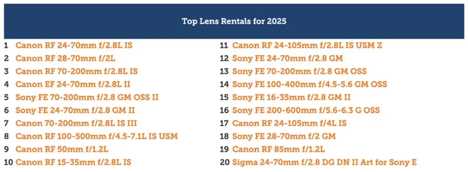
When it comes to top lens rentals, it is Canon and Sony all the way to number 20: the
Sigma 24-70mm f/2.8 DG DN II Art for Sony E. It is also a list heavily skewed toward zoom lenses, with just two prime lenses making the list. The Canon RF 50mm f/1.2L and RF 85mm f/1.2L, a pair of fast, professional portrait primes, landed on the list in ninth and 19th positions. As Lensrentals notes, the most-rented lenses are all very standard, practical choices that work for a broad range of shooting situations.
Lensrentals also tracks revenue shares by brand, further illustrating the dominance of Canon and Sony. Both companies gained revenue share this year compared to last, with Canon reaching 26.5% and Sony hitting 21.7%. Nikon is in a very distant third at 5.6%.
While Fujifilm is a very popular camera brand among purchasers, it has historically lagged behind other brands in rentals. That hasn’t changed in 2025, either, with the brand at 2.8% revenue market share. While this is actually up slightly from 2024, it still trails behind DJI, Blackmagic, and Sigma. The next major camera brands are Panasonic (2%) and Leica (1.5%).
Check out the awesome products that TrueSonic Inc. offer.
https://shareasale.com/r.cfm?b=2145237&u=3952045&m=130968&urllink=&afftrack=
Check out all the awesome stuff at Moment for your photography/videography needs!
https://partner.shopmoment.com/4PDeVG
Save on your orders for SmallRig gear
If you'd like to pick up your own HOVERAIR XR Drone use the following link
https://thehover.com/products/hoverair-x1-self-flying-camera-combo
and code XMHOVER to save $20
Get your own discount on VITURE XR One glasses, Neckband, Switch Dock and more!
https://shop.viture.com/?ref=LiamPhoto
Check out the latest deals at OWC (Other World Computing) for all your Apple/Mac needs.
https://eshop.macsales.com/shop/specials/?utm_source=affiliate&utm_medium=text&utm_campaign=cj
Get low cost SSLs for your sites here.
Sign up for VidIQ using the following link:
https://vidiq.com/liamphotoatl
Check out my ThinkTank Affiliate link. When you buy using this link you help the channel, pay nothing extra and can even get a free item!
I now have my own discount code for my Subscribers and Podcast audience at http://www.platypod.com use my code WD20 to get 20% off on any Platypod branded items, excluding bundles which are already discounted by 20% or more. One user per customer.
I also have an affiliate code for Dehancer Film profiles at http://www.dehancer.com and use code LDPHOTO
Check out the awesome gear Ulanzi has for photographers and Content Creators!
https://www.ulanzi.com?aff=1002
You can buy me a coffee: https://www.buymeacoffee.com/liamphotoaf
Also be sure to join the Liam Photography Podcast Facebook Group https://www.facebook.com/groups/liamphotographypodcast/ You can reach the show by call or text @ 470-294-8191 to leave a comment or request a topic or guest for the show. Additionally you can email the show @ liam@liamphotographypodcast.com and find the show notes at http://www.liamphotographypodcast.com.
You can find my work @ https://www.liamphotography.net and follow me on Instagram, Facebook and Twitter @liamphotoatl. If you like abandoned buildings and history, you can find my project @ http://www.forgottenpiecesofgeorgia.com. and http://www.forgottenpiecesofpennsylvania.com.
Please also stop by my Youtube channels Liam Photography


















Comments & Upvotes